Fire Extinguishers
It is a requirement of the Regulatory Reform (Fire Safety) Order 2005 that you provide suitable means of fighting fire.
Potentially the most recognisable form of fire safety equipment, Fire Extinguishers usually represent the first line of defence in the event of a fire. Our knowledgeable engineers will ensure that you are prepared for any fire eventuality.
All new Fire Extinguishers should be subject to commissioning before being installed – a process that must be carried out by a competent person. Upon removal from its packaging, and immediately prior to placing in its designated place, the Fire Extinguisher must undergo the sequence of commissioning service actions.
We provide a full supply, commissioning, installation and maintenance package to BS 5306 : Part 3 : 2017 to ensure that you have the required Fire Extinguishers for your premises in accordance with the Regulatory Reform (Fire Safety) Order 2005.
Once installed, we offer routine Annual Servicing of the Fire Extinguishers. This confirms their functionality and performance ensuring that they remain in full working order and are legally compliant. We can also deliver training so that your staff are confident in how to use the Fire Extinguishers if the situation arises.
Having appropriate fire protection in place is critical for insuring your property and meeting local authority regulations.
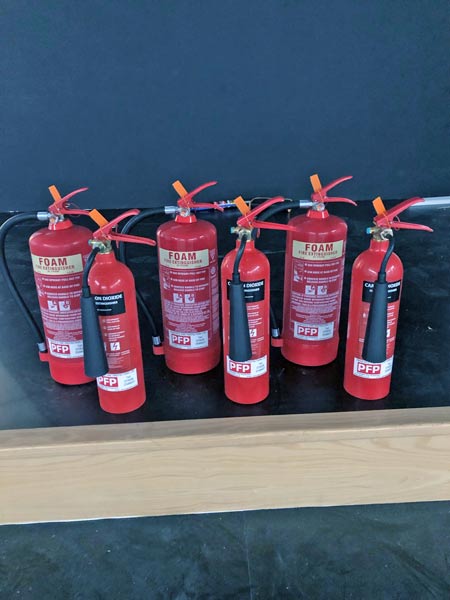
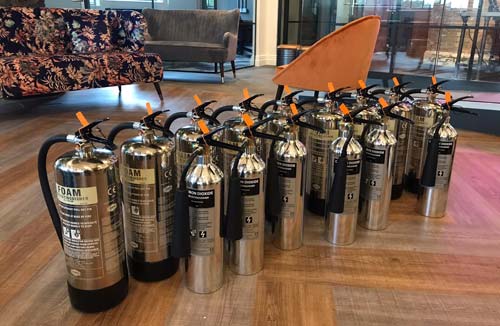
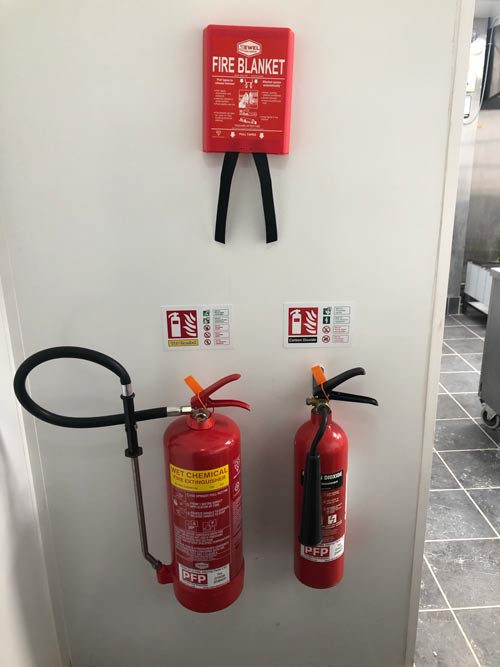
In the UK, there are at least 6 types of Fire Extinguishers in mainstream use:
- Water
- Carbon Dioxide
- Powder
- Foam
- Wet Chemical
- Water Mist
These extinguisher types are selected to specifically target one or more of the 6 classes of fire identified with the letter A-F in the UK:
- Class A fires are fuelled by solid materials such as plastic, wood, paper, textiles and furniture. Most of these materials are organic in nature.
- Class B fires are fuelled by flammable liquids such as oil, paraffin or petrol.
- Class C fires are fuelled by flammable gases such as methane, propane or butane.
- Class D fires are fuelled by ignited metals such as titanium, aluminium or magnesium.
- Class E fires are fuelled by electrical appliances such as TVs, computers and hair dryers.
- Class F fires are fuelled by cooking fats or oils e.g. in a kitchen setting.